
My Cart
₹0.00
 |
 |
 |
 |
 |
|
||
| Code | art. no. | inch | Nm | Nm | mm | mm | inch |
| 05074840001 | 7460 ESD | 1/4″ | 0.3 | 0.3-1.2 | 105 | 155 | 6″ |
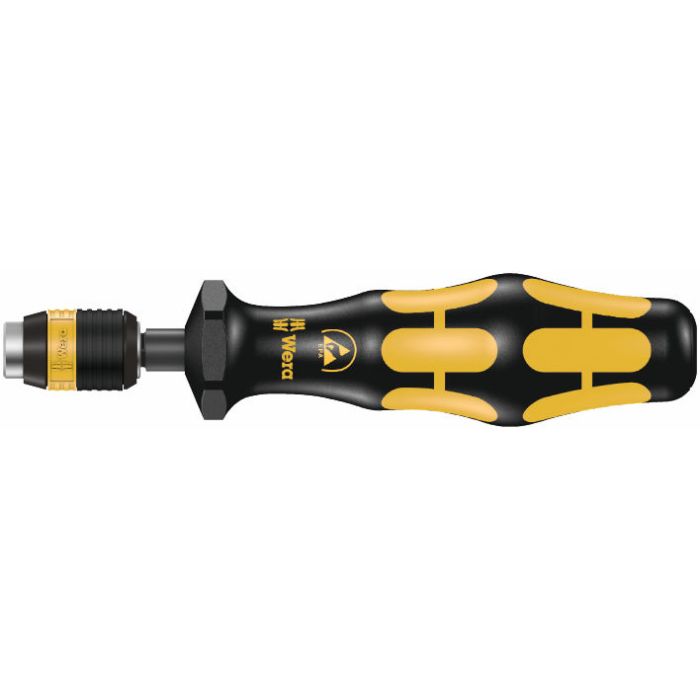
Wera torque screwdrivers. With a factory pre-set torque value set to the smallest scale value. For all applications, where the same constant torque and repeat accuracy are required. The torque can be changed with an extra tool within the measuring range (re-calibration kit can be ordered with the code number 05137001001). Afterwards you can check the set value using an off-the-shelf torque tester.
The requirements for ESD-safe screwdrivers are specified in the European standard DIN EN 61340-5-1. This standard also includes a handle that has to be out of a defined conductive material. The Wera products in the ESD series satisfy these standards and the even more stringent requirements demanded by some technology companies.
The electric surface resistance of the Wera ESD material is ≤ 109 ohm. This securely protects components against electrostatic energy and associated damage.
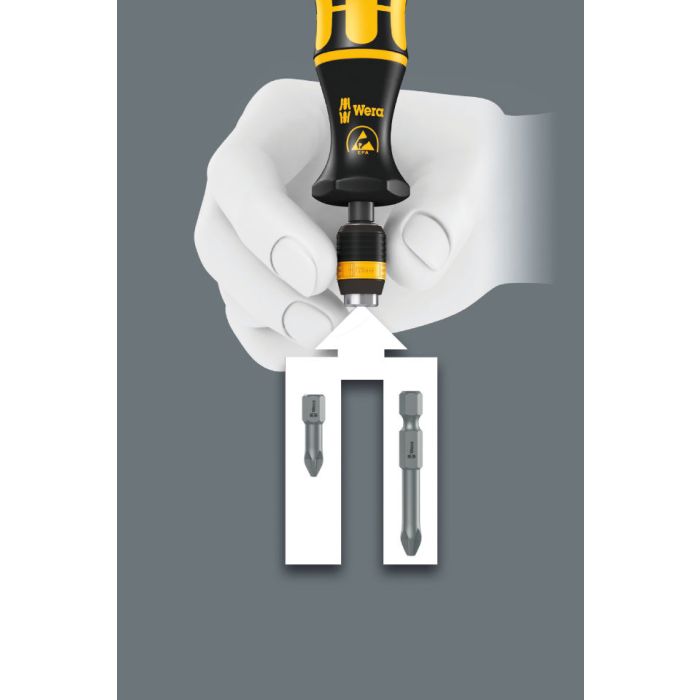
Rapidaptor technology makes the tool adaptable since bits and sockets can be exchanged rapidly.
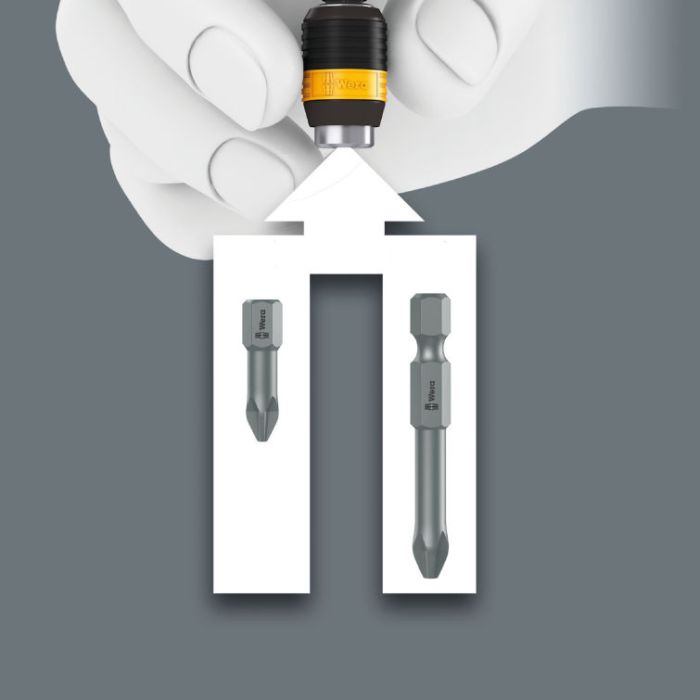
The Rapidaptor quick-release chucks hold ¼” DIN ISO 1173-C 6,3 and E 6,3 as well as Wera series 1 and 4 bits.
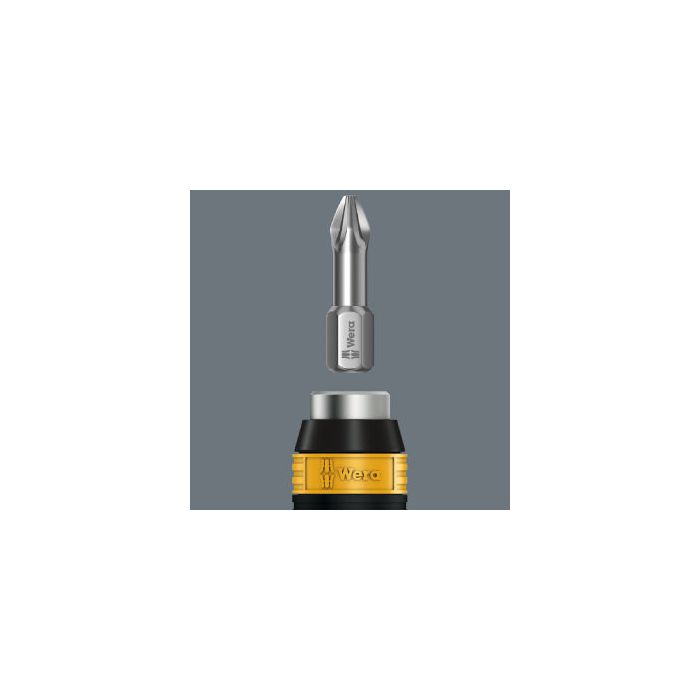
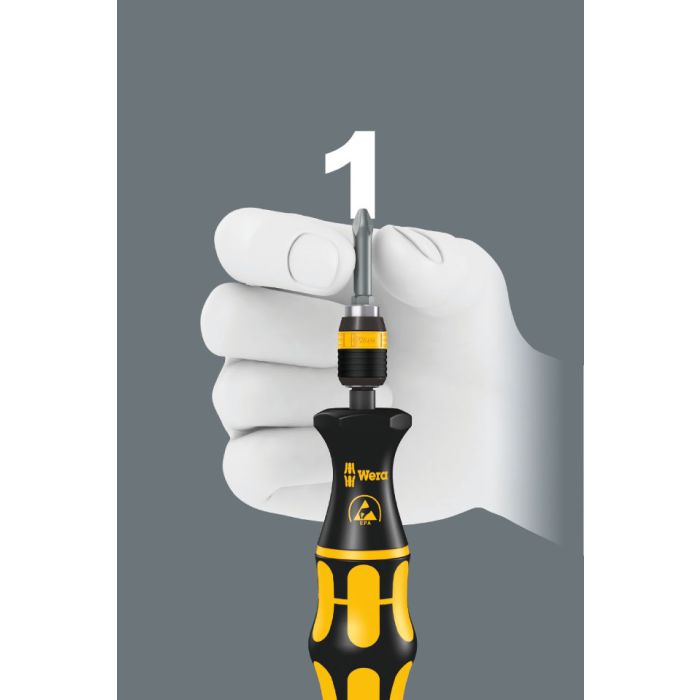
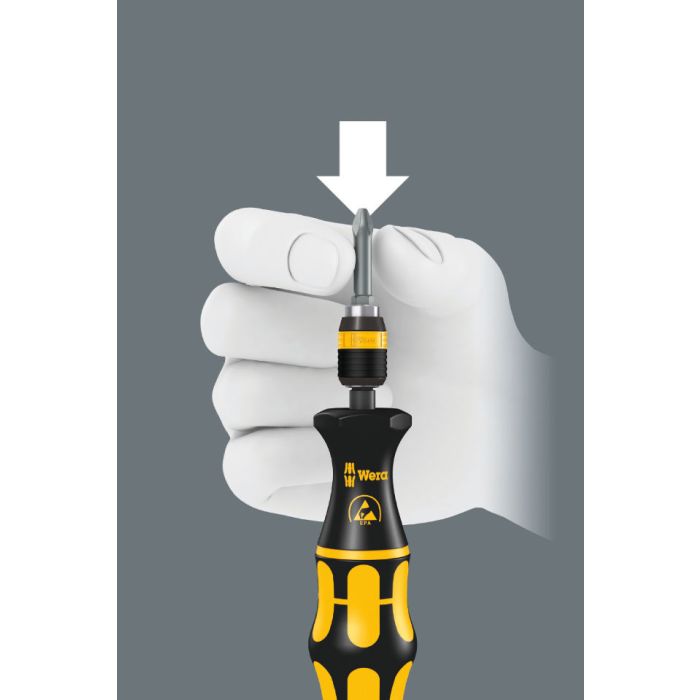
The bit can be pushed into the adaptor without moving the sleeve. The lock is activated automatically as soon as the bit is applied to the screw. Bits are held securely and wobble-free.
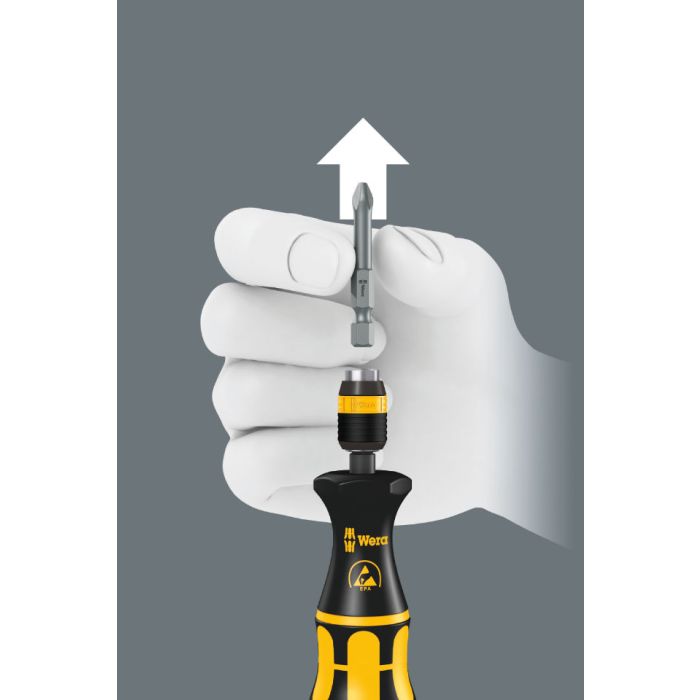
Simply push the sleeve forward to change the bit. The spring mechanism lifts the bit off the magnet and unlocks the tool. The bit can be easily removed. The rapid-out function makes it easy to remove even the smallest bits without extra tools.
The basic idea for the prototype of the Kraftform handle – that the hand should dictate the design – has, right through to today, proved to be correct. In cooperation with the internationally recognised Fraunhofer IAO Institute, Wera developed a screwdriver handle designed to match the shape of the human hand as long ago as the 1960s. After a long development phase, the Wera Kraftform handle was launched to the market in 1968. It has been optimised through the years with new technologies, but has kept its proven shape. After all, the human hand has not changed either.
|
|
|
|
|
|
||
| Code | art. no. | inch | Nm | Nm | mm | mm | inch |
| 05074840001 | 7460 ESD | 1/4″ | 0.3 | 0.3-1.2 | 105 | 155 | 6″ |
Wera torque screwdrivers. With a factory pre-set torque value set to the smallest scale value. For all applications, where the same constant torque and repeat accuracy are required. The torque can be changed with an extra tool within the measuring range (re-calibration kit can be ordered with the code number 05137001001). Afterwards you can check the set value using an off-the-shelf torque tester.
The requirements for ESD-safe screwdrivers are specified in the European standard DIN EN 61340-5-1. This standard also includes a handle that has to be out of a defined conductive material. The Wera products in the ESD series satisfy these standards and the even more stringent requirements demanded by some technology companies.
The electric surface resistance of the Wera ESD material is ≤ 109 ohm. This securely protects components against electrostatic energy and associated damage.
Rapidaptor technology makes the tool adaptable since bits and sockets can be exchanged rapidly.
The Rapidaptor quick-release chucks hold ¼” DIN ISO 1173-C 6,3 and E 6,3 as well as Wera series 1 and 4 bits.
The bit can be pushed into the adaptor without moving the sleeve. The lock is activated automatically as soon as the bit is applied to the screw. Bits are held securely and wobble-free.
Simply push the sleeve forward to change the bit. The spring mechanism lifts the bit off the magnet and unlocks the tool. The bit can be easily removed. The rapid-out function makes it easy to remove even the smallest bits without extra tools.
The basic idea for the prototype of the Kraftform handle – that the hand should dictate the design – has, right through to today, proved to be correct. In cooperation with the internationally recognised Fraunhofer IAO Institute, Wera developed a screwdriver handle designed to match the shape of the human hand as long ago as the 1960s. After a long development phase, the Wera Kraftform handle was launched to the market in 1968. It has been optimised through the years with new technologies, but has kept its proven shape. After all, the human hand has not changed either.


Reviews
There are no reviews yet.